2.19 Exhibitions
AAG Aotearoa Contemporary
The idea behind Aotearoa Contemporary is to “cultivate a new generation of artistic voices, providing a showcase for what is new and current in Aotearoa New Zealand’s diverse cultural environment with its dynamic history of contemporary art.” It’s set to occur every three years.
The emphasis is on emerging and less visible practitioners, focussing on artistic breadth and art’s role in this country in responding to and generating new creative ideas and forms.
There were 27 artists featured and much to take in at the end of a long day, so I was drawn to the work that looked like it was engaging with similar territory as mine.
Emerita Baik

Emerita Baik, Seafoam beyond the glittering stars, 2024, screenprint,
ink and acrylic on paper.
Her practice experiments with the potential of materials and forms to imitate or morph into another. She combines imagery from her home in New Zealand, text messages from KakaoTalk, a Korean messaging app, and references to The Little Mermaid, layering all these elements to present popular ideas and tropes of family, journey and sacrifice.
I found myself looking for evidence of the elements mentioned in the accompanying wall text but I couldn't see it, so instead I found myself looking at the way they were made. Unlike my work, they are fixed in place, and it drilled home to me how much my work benefits from the tension of being temporarily held together.
Mending the Kupenga, Arielle Walker at Te Wai Ngutu Kaka, 28 June - 19 July, 2024.

Arielle Walker, whatuwai, 2022 - (ongoing).
"Arielle Walker (Taranaki, Ngaruahine, Ngapuhi, Pakeha) is an artist, writer, and maker, whose practice seeks pathways towards reciprocal belonging through tactile storytelling and ancestral narratives, weaving in the space in between." (from Ngutu Kaka exhibition text.)
Time, place, and ancestral narratives are woven together in these works, made on hand-crafted warp-weighted looms. There was a liveliness to the work because it can be unpicked and re-woven, drawing on ideas of reclamation, renewal, and relation.
Acts, Nicholas Mangan, Shiraz Sadikeen, Sriwhana Spong, Luke Willis Thompson, at Coastal Signs, 12 July - 3 August 2024

Acts, installation view, Coastal Signs.
I was really impressed by the installation choices made for this group show. The sparseness, tied together with the colour chosen by Shiraz Sadeen, gave each work a kind of gravitas, or weight, and allowed each piece its due attention.
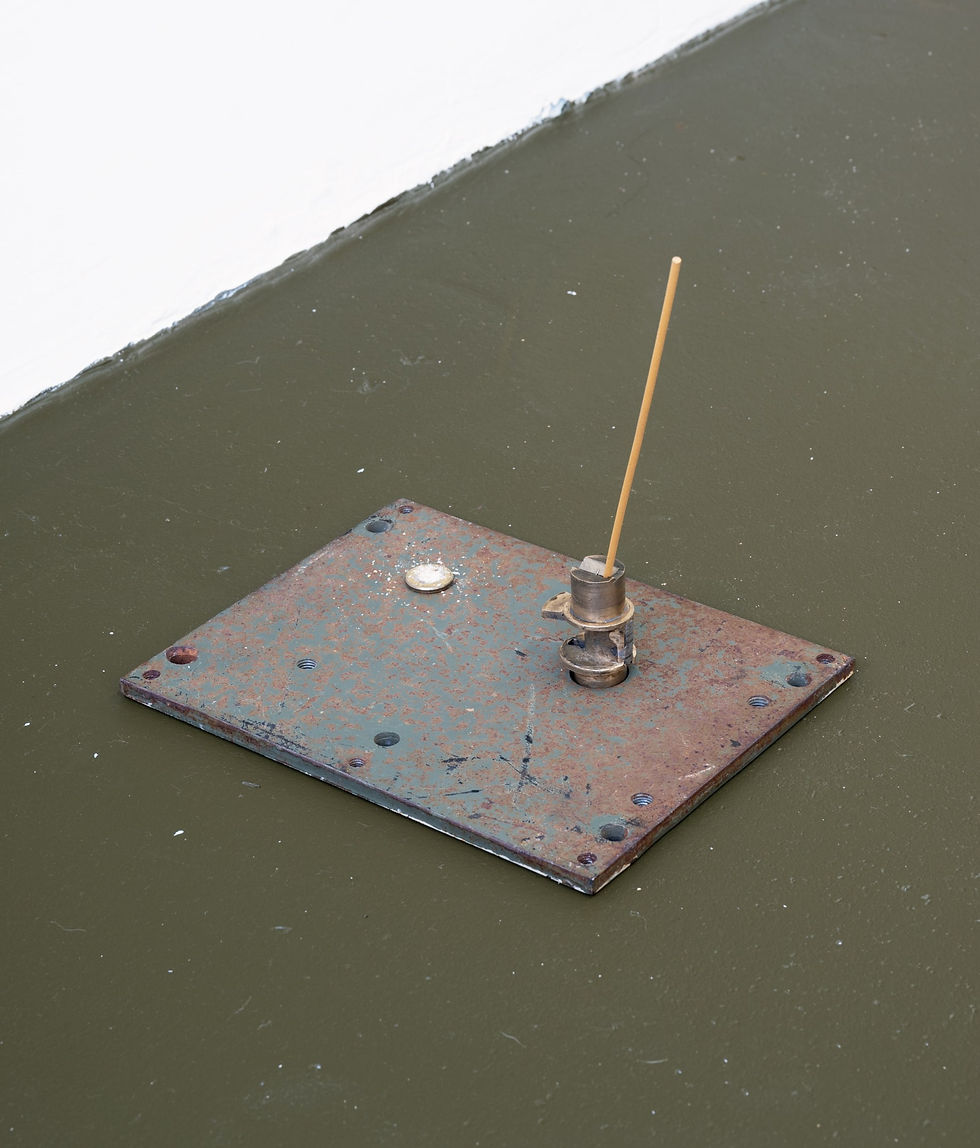
Shiraz Sadikeen, Small Plate, 2024, strike plate and key rotor
components of cell door lock from Mount Eden Prison, incense,
one dollar coin, bread crumbs.
This work by Shiraz Sadikeen was particularly compelling, even before I read the list of materials from which it was made. Sadikeen "makes paintings and sculptures that mediate their own conditions of production and reception. Often made using ready-made or found materials, as well as various processes of abstraction and formal displacement, Shiraz's work explores the associations between these objects and the situations from which they originally derive." By combining these seemingly disparate elements he shifts the narrative of their original purpose.
Derek Jarman, Delphinium Days, Gus Fisher Art Gallery, 15 June 2024 - 26 January 2025.

Derek Jarman, Drop Dead, 1993.
I had only known Jarman's work through his films, so this exhibition provided me with a much richer understanding of his prolific practice. He was was an artist, film maker, costume designer, stage designer, writer, poet, gardener, and gay rights activist. I was particularly drawn to his extraordinarily raw and powerful paintings. He deftly combined activism and art and didn't shy away from being up-front and in-your-face about it.

Derek Jarman, I.N.R.I, 1988.
Michael Mahne Lamb, Through Points, Te Wai Ngutu Kaka. 26 July - 13 October 2024.

Michael Mahne Lamb, Wall Suspension I (22015-2), 2024.
Photo-sculpture hybrids - right up my alley. I make painting-sculpture hybrids.
The exhibition text, written by Stephen Cleland, describes the two ideas at play in this exhibition. "First is the idea of the aperture, both the lens and the in-situ architecture. These 'through points' continually interact, as the unnamed architectural spaces pictured in the photographs eerily echo our immediate urban surrounds." The second is "the unusual way in which the prints are channeled through the unique supports. While this sculptural play further emphasises the abstract quality of the works, paradoxically it also further stresses the ontology of the medium, as if the winding journey of the prints through the acrylic echoes the prior journey of the film through the camera."
I was interested in the way that these objects give and deny access at the same time. Where the print loops through the 'through point' it becomes vulnerable and fragile, open to the possibility of being touched. But behind the perspex it's protected, less available, and more a part of the architecture, as the perspex structures occupy space and reflect the architecture and lighting of the room.
There's great restraint in the way that they mostly only bend one way. I'm always looking for new ways to bend my materials, so that sometimes I think the bendy-ness is too much. Just because something can bend doesn't mean it always should.
Richard Killeen, Hang In Any Order, Gow Langsford, 3-27 July 2024.

Richard Killeen, Know this place, 1993, acrylic and collage on aluminium, 27 pieces.
Richard Killeen, Know this place, 1993, details.
Questioning the idea of artistic authorship, these cut-outs "break down conventional artistic boundaries, and invite interpretation and dialogue". They can be installed in any configuration, as the title for the exhibition suggests, hung in any order. The images are disparate with no clear narrative order, so the viewer can read the work in any way that works for them, similarly, a buyer could install the work in any way.
They have a relationship to Matisse's cut-outs, but they are painted on aluminium, so they are more robust, allowing for a greater degree of installation play, and they are, as Killeen puts it, "democratic" in that the images are non-hierarchical, and they empower the viewer to make their own readings.
The idea of being endlessly reconfigurable is something I'm still working on. The more individual pieces I have to work with, the more achievable this becomes.


Comments