2.4 Studio February-April
- kerincasey
- Apr 8, 2024
- 4 min read

First up, one more experiment with small work. I had some liquid latex and wanted to test how it might work adding acrylic, layering it up, and seeing how structural it might be in terms of holding space. It works pretty well, but it's super toxic and expensive. I don't think it would be a feasible material to scale up. Also I shouldn't have used this pink colour with it. It looks too fleshy. But I like the contrast of the stretch and the inverse fold.
Now on to scaling UP.
I wanted to make something as big as I could physically deal with on my own, using pieces bigger than my wing span. I was also wanting to work agonistically - making something that was 'finished for now', then re-configuring and adapting over weeks until I felt like the work landed in a place where it seemed to have become its own entity. I've discovered another litmus test for a work feeling landed, is when I come into the studio the day after making it and the work surprises me and I think 'how did I make that?'.

I started here, to get a sense of scale, and to consider some of the practical impacts of working larger, like weight, balance, gauge, and tolerance (of the bendy ply, not me). Adding a panel created a new structural problem to solve, so I leaned into that and added on.

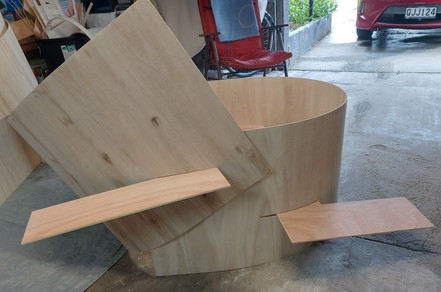


This was about three weeks of doing and undoing until it landed in this very closed in structure that certainly held space, but shut out the viewer and didn't invite closer inspection. It felt like one lump that could be viewed at a glance.
So I took it apart and worked on opening it out in a number of iterations.


Changing the core structure of the solid ply helped to give this piece some life. There was something in the squashiness that was starting to interest me here.


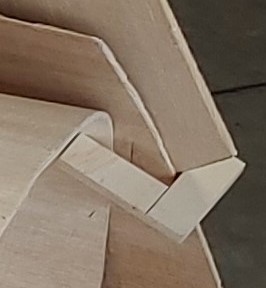
Eventually I worked my way to this, which surprised me and kept changing as I walked around it. I considered leaving the plastic clamps on it, which act as another pair of hands for me while I'm making, and were illustrative of the agonistic nature of the work, but they stood out so much, they became too much of a focal point. They also felt like a bit of a cheat. So I tried making a small wooden piece that acted like a clamp, but that seemed wrong too. Using wood worked, but the small scale seemed out of place, like it was trying to be inconspicuous but in doing so was really obvious.

I made a much bigger piece (left of frame in the above pic) that was an interesting piece in itself, at the same time acting as a clamp of sorts.
Over the weeks of making this large floor piece there were many moments where I just needed to park it and let it sit, and give me some distance from it, which gave me time to work on two wall pieces. This first one developed from an off-cut. I've found that some good work comes out of off-cuts, because they're essentially negative space turned positive, and they haven't been overly considered by me. (Jeena Shin works this endlessly generative way).

I started playing with this piece, again working in a 'finished for now' way. I started working with it as a floor work, and experimenting with trying to get it free standing. I liked the off-cut shape so much that I duplicated it and tried fitting one inside the other. Whenever I looked at it I just thought 'chair', and again it became too closed in. I wanted to give it height and get it on the wall.

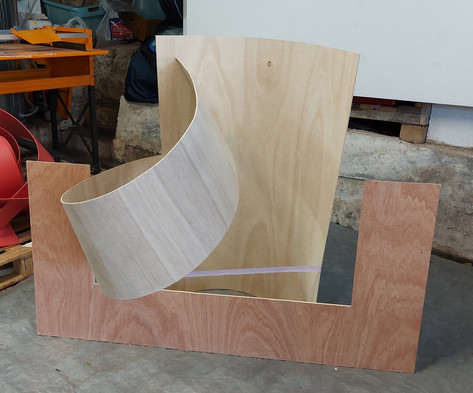

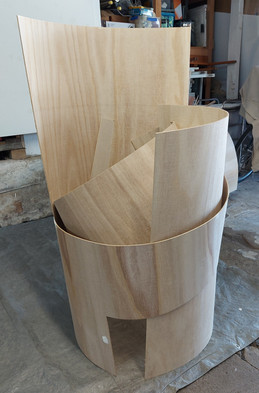


After much experimenting, this is where it felt right.
Then I wanted to make a piece that was really opened out. I wanted to see how shallow a piece could be while still holding space.


This one moves as you walk past it, and it's open enough that you can actually get into it. I resisted the urge to attached the outer piece at the end. It was much more interesting to have it floating. It could still work in the fully open position of the first pic as well.
Then to painting. People often comment that they think my work should be made out of metal. Two reasons why I don't do that at this point in my Masters. I can't afford it - it would require a whole new set of tools and materials I don't have. And it would require a few years of learning and experimenting to get me to a level of knowledge equal to the level I have with working with wood. Three reasons - weight. Metal is much heavier than ply. To work at a large scale I'd need another pair of hands and a forklift.
But the metal comments gave me the idea of using metallic paint. It also plays into the idea of defying the modernist truth to materials, by painting wood to look like metal. I'm really pleased with the results. I've put one piece back together, but the other two will be assembled on site for April seminar, so I'm keeping those ones in pieces for now. This one really comes to life when the sun hits it.


Comments